Service
RV air conditioner repair in Pahrump
An RV air conditioner that stops cooling in a Pahrump July is an emergency, and it is also usually a cheap fix. The two most common failures on a rooftop unit are a capacitor and a fan motor, both of which are a part and an hour or two of labor. A full replacement runs $800 to $2,500 all in, and most people who are quoted that number did not need it. Call to get connected with a licensed local RV technician who will come to the rig and find out which one you are.
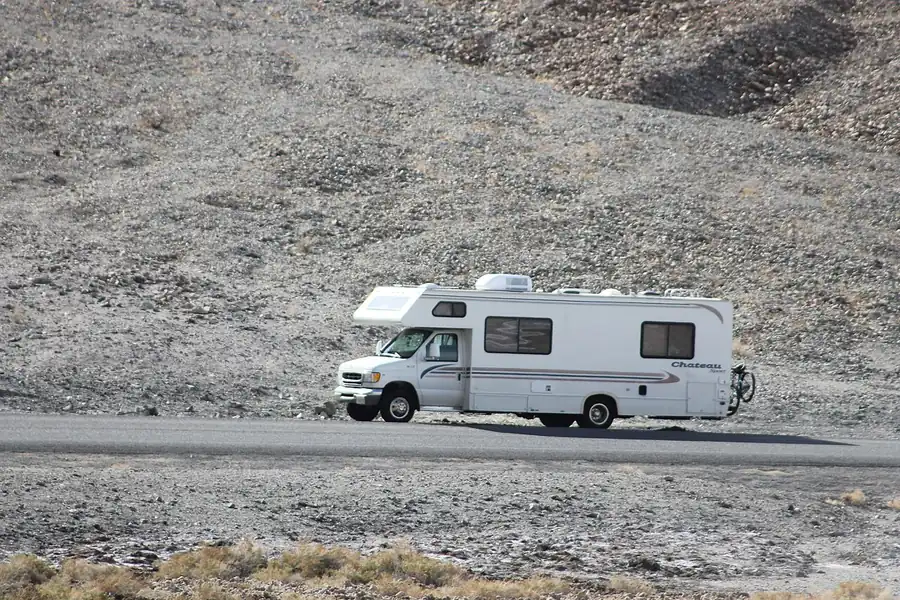
Why rooftop units die here specifically
Because they never cycle. That is the whole answer.
A rooftop RV air conditioner is designed around an assumption: that it runs, satisfies the thermostat, shuts off, and rests. In most of the country that is what happens. The unit works in bursts, and the off time is when the motor cools, the capacitor cools, and the compressor gets a break.
In Pahrump in July, the unit reaches the thermostat setpoint sometime in October. It does not cycle. It runs, at full capacity, all day and most of the night, for months, on a roof that is itself well over 140 degrees in direct sun. Nothing on that unit was engineered for that, and the parts fail in a predictable order. It is why a technician working this valley can hear "my AC quit" in August and have a short list before they arrive.
The common failures, in order
Roughly in order of how often they turn up, and conveniently, roughly in order of cost.
1. The capacitor
The most common failure by a wide margin. The start and run capacitor is a small component that gives the motors the kick they need to get going and keeps them running smoothly. Heat is what kills capacitors, and this is the hottest place they could possibly live. The classic symptom is a unit that hums but the fan does not spin, or a compressor that tries to start, clicks, and gives up. It is a part and an hour. If your AC quit on the hottest day of the year, start hoping it is this.
2. The fan motor
Second on the list, same reason. The motor that pushes air across the coils runs continuously for months and eventually the bearings give up. You will often hear it coming: a squeal, a grinding, a rattle that was not there last year. Sometimes the fan still turns but has lost enough speed that the unit cannot move heat, and it reads as "not cooling" rather than "not running." Also a part and an hour or two.
3. Frozen coils from restricted airflow
Counterintuitive but common. If the unit ices up, the cause is almost never too much cold. It is not enough air moving across the evaporator, so the coil drops below freezing and grows a block of ice, which further blocks the air, which makes more ice. Restricted airflow means a filthy filter, a blocked return, closed registers, a failing fan, or a collapsed duct. The tell is an AC that cools acceptably for an hour then slowly stops, and drips a lot when you shut it down. Caught early, the fix is often just cleaning something.
4. Dirty coils full of desert dust
Pahrump is a valley of fine dust, and a rooftop unit is a machine whose entire job is pulling air across metal fins. Over a season those fins pack with dust and the unit loses the ability to reject heat to the outside. Nothing is broken. It just cannot do its job anymore. This is maintenance rather than repair, and it is the cheapest performance gain available on an RV in this climate.
5. The compressor
Last, and the bad one. A compressor that has died is generally the end of the unit, which we will get to.
AC out and it is 110 outside? Describe what it is doing on the phone.
When replacement is genuinely the answer
When the compressor is dead. That is close to the only case, and the reason is structural rather than financial.
A rooftop RV air conditioner is effectively a sealed appliance. It is not a home split system where a technician can open the refrigerant circuit, replace a component, and recharge it. These units are built as a closed assembly and are not designed to be opened in the field. Once the sealed side has failed, you are replacing the box. That is not a technician upselling you. That is how the product was built.
Everything outside the sealed side is fair game: capacitor, fan motor, thermostat, control board, wiring, gaskets, shroud. Those are repairs, and they are the reason "not blowing cold" should never be met with a replacement quote before someone has been on the roof.
The genuine gray zone is age. A fifteen year old unit that has spent its life in this valley and now needs a $400 repair is a real conversation, because the next thing to fail may be the compressor and then you paid $400 for nothing. There is no clean rule, just an honest look at the unit and a straight conversation, which is what the cost page tries to set you up for.
Ducted or non-ducted, and why it changes the diagnosis
Non-ducted units dump air straight out of the ceiling assembly into the room through the vents on the unit itself. Simple, and when something is wrong it is usually in the box you are looking at.
Ducted units feed a run of ductwork in the ceiling with registers scattered through the coach. That adds failure points which have nothing to do with the air conditioner: a duct separated at a joint, a section crushed during a repair, insulation sagging into the path, or a return blocked by whatever is stored against it. A ducted rig that cools the front bedroom and does nothing at the back may have a perfectly healthy AC and a duct problem. Ducted systems also freeze up more readily, for the same reason. Tell the technician on the phone which one you have, because it shapes what they check first.
Soft starts, generators, and 30 amp service
The hardest moment in an air conditioner's life is the instant it starts. The compressor draws a big surge of current for a fraction of a second, several times its running draw. Shore power at a decent park shrugs that off. A generator or a marginal 30 amp pedestal does not always.
This shows up as a unit that will not start on the generator but works fine at the park, a breaker that trips on startup, or a rig on 30 amp service that runs one AC fine and refuses to add a second. None of that means the AC is broken. It means the surge is bigger than the supply can deliver.
A soft start smooths that surge out over a couple of seconds instead of demanding it all at once. It is genuinely good kit for anyone running AC on a generator or living on 30 amp. It is not a fix for a unit that will not cool. It is a fix for a unit that will not start.
And if you are boondocking past Beatty or camped in Death Valley and the AC will not run on the generator, the generator itself may be the actual patient. The generator page covers that.
What a working RV AC can actually do
A rooftop RV air conditioner pulls the interior down roughly 20 degrees below ambient. That is what the machine does when it is healthy, clean, and correctly sized for the coach.
Run that math for here. At 115 degrees outside, a perfect unit gives you a rig in the mid 90s. Not 68. Not close to 68. And a large number of the AC calls in this valley are for units that are working exactly as designed, being judged against a house thermostat.
That is not a reason to skip the call, because the difference between a healthy unit and a dust-packed one is real and you will feel it. But it is worth knowing before you pay a trip fee to be told your AC is fine. If your rig is 95 inside when it is 115 outside, the AC is not the problem. Shade, reflective window covers, running the fan continuously, and not opening the door are the levers you actually have. The rigs that suffer most are the ones parked in full sun on gravel with no awning, which describes most of Pahrump in summer.
Check these before you call
Four things, all free, all of which a technician will check first anyway and charge a trip fee to do.
- The breaker. Both of them: the one in the rig's panel and the one on the pedestal. A tripped breaker is a real fraction of RV service calls and it costs a full minimum charge to have someone flip it.
- The filters. Pull them and look. In this dust they load up faster than anyone expects, and a packed filter is the most common cause of a unit that cools weakly or freezes.
- The thermostat. Correct mode, setpoint actually below room temperature, and on a multi-zone system, the right zone. Swap the batteries on a wireless one before you assume the AC is dead.
- The coils. If you can safely get on the roof, take the shroud off and look. Fins gray with dust are at least part of your answer.
If those four are clean and it still will not cool, it is a real problem and it wants a technician. More in the FAQ.
AC questions
My AC runs but the air is barely moving. What is that?
Usually one of three things, in this order: a loaded filter, a fan motor losing speed, or a coil that has iced over and is now blocking its own airflow. Shut the unit off, leave the fan running for an hour, and see if the air comes back. If it does, you had ice, and the ice had a cause worth finding. If the air was weak from the start and never improves, look at the filter, then the motor.
Why does it cool fine at night and quit in the afternoon?
Because the unit is marginal and the afternoon is when the margin runs out. A dust-packed condenser coil, low airflow, or a tired compressor can all keep up at 85 degrees and fall behind at 112. Almost every AC in this valley that is on its way out announces it this way first, and that is the cheapest moment to catch it. Waiting means catching it in the worst week of the year, when everybody else's is failing too.
Can a technician add refrigerant to my rooftop unit?
Generally no, and be careful with anyone who says yes. Rooftop RV air conditioners are sealed assemblies without service ports, and they are not designed to be charged in the field. If a unit is genuinely low on refrigerant it has a leak, and there is no field repair for that on this kind of appliance. A unit that is not cooling is far more likely to have a capacitor, motor, airflow, or coil problem, and those are all fixable.
How fast can somebody get to me if I am out toward Death Valley?
It depends on the day and the distance, and anybody promising a time without knowing where you are is guessing. Be specific on the phone about where the rig is sitting, because a tech who knows they are driving an hour and a half plans the day around it and brings the parts that matter.
Get connected with a licensed local RV technician.